
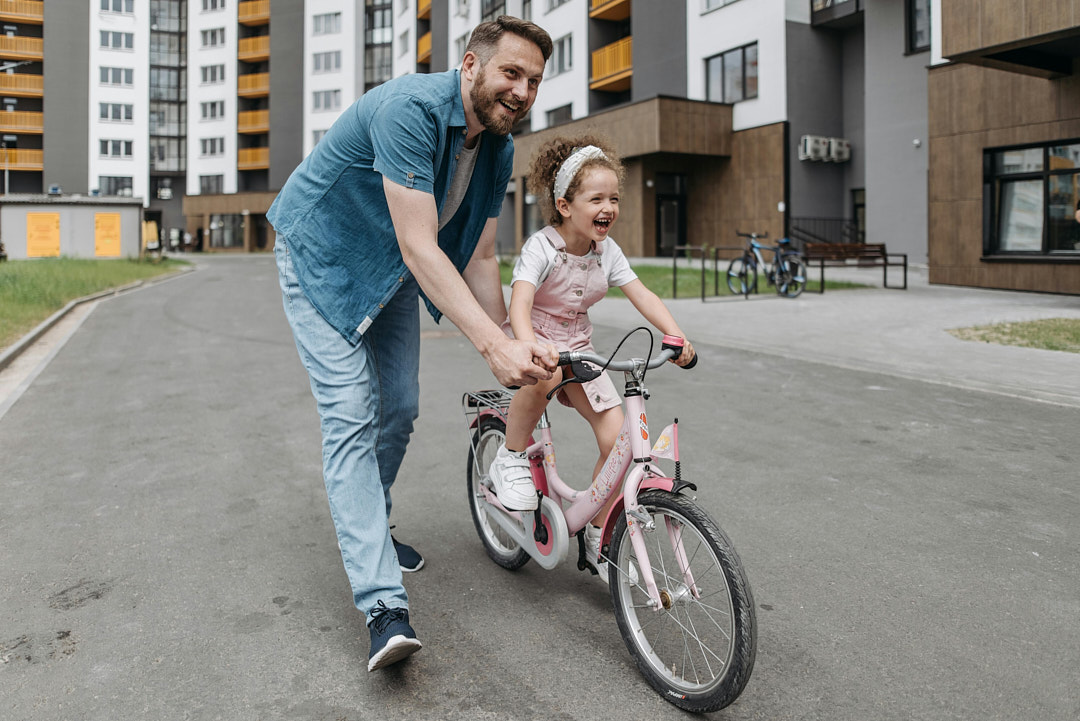

Last week, as I knelt in our yard, I found myself deeply immersed in my daughter's world of wonder and exploration. At 3, her universe is vast, filled with the magic of the everyday. From the glistening dew on morning petals to the intricacies of a ladybug's path, everything holds the promise of discovery.
It was on this day, under the comforting shade of her swing set that she decided to conquer her very own 'mountain' — the swing set with neighbouring tree fort. To my adult eyes the ladder was insignificant but to her it represented a challenge, a peak to be ascended. As she took her first tentative steps, I felt a familiar twinge of parental anxiety. Memories of scraped knees and teary eyes flooded my mind. Every instinct within me screamed to rush to her side, to shield her from potential tumbles, to cocoon her in a bubble of safety. But, in that crucial moment, I chose to remain still, watching and waiting.
With every step, her initial hesitation transformed. Each small victory, each obstacle overcome, infused her with a confidence that was beautiful to behold. Her joyous laughter, her triumphant little shouts of "I did it, Daddy!" filled the air, and the yard seemed to celebrate with her.
Yet, it wasn't all smooth sailing. There were missteps, moments where balance was lost, leading to tiny slips and falls. My heart lurched with each one, and I had to clench my hands to stop myself from intervening. But with each fall, she showed a resilience that left me in awe. She'd pause, assess her scraped knees or dirt-covered palms, and then, with a determination that belied her age, she'd rise and continue her ascent.
This microcosm of life unfolding in our yard was a profound lesson for me. It brought into sharp focus the delicate balance of parenting: the perpetual dance between protection and empowerment. At 3, my daughter is at the cusp of understanding her capabilities and her boundaries. Each day presents myriad opportunities for her to push these boundaries, to explore, learn, and grow. And as her father, my role is not just to safeguard her but to ensure she has the space and the encouragement to take these age-appropriate risks.
As the afternoon sun cast long shadows, and her mountain was conquered multiple times, I realized that these moments, while seemingly insignificant, are foundational. They lay the groundwork for her self-belief, her ability to face challenges head-on, and her understanding of both her strengths and her limitations.
By the time we headed indoors, my heart was full — not just with pride for my daughter's tiny yet significant achievements but with a newfound clarity. I understood that my journey as a parent would be filled with countless such moments, where I'd need to grapple with my protective instincts. And while the path wouldn't always be easy, the reward — watching her blossom into a confident, resilient individual — would be worth every heart-stopping moment.
Understanding the Essence of Age-Appropriate Risks
Navigating the developmental milestones of children, from infancy to adolescence, requires parents to constantly recalibrate their understanding of risks. At the heart of this is the concept of age-appropriateness. What might be a negligible challenge for a 10-year-old can be a monumental task for a toddler. Similarly, a teen's world of challenges is an entirely different spectrum from that of younger children.
For infants and toddlers, the world is a vast playground waiting to be explored. Age-appropriate risks here might include allowing them to explore different terrains under supervision, encouraging them to pick up varying sizes of safe objects, or introducing them to water play. These activities enhance sensory development and motor skills but need to be closely monitored for safety.
As children transition to school-age, their sphere of exploration extends beyond the immediate environment. Letting them solve puzzles, navigate friendships, or participate in physical activities like climbing or cycling becomes crucial. These risks develop problem-solving skills, resilience, and physical coordination.
Teenagers, on the other hand, grapple with a world that's both real and digital. Their risks encompass navigating peer pressures, making decisions about substance use, or managing their digital footprint. Here, the role of parents shifts from direct supervision to guidance, ensuring teens have the tools to make informed decisions.
The Rewards of Risk
Navigating the uncertain waters of risk, especially when it involves our children, is inherently daunting for most parents. However, there is an array of invaluable rewards waiting on the other side of these challenges.
1. Building Resilience
Every small challenge or setback a child faces and overcomes adds a layer to their resilience. This adaptability and mental toughness will be their shield in the face of future adversities, teaching them that they can recover from hardships and emerge stronger.
2. Developing Problem-Solving Skills
Encountering a risk means facing a problem head-on. Whether it's figuring out how to climb a playground structure or navigating the complexities of teenage relationships, these experiences hone a child's ability to think critically, weigh outcomes, and make decisions.
3. Fostering Independence
When children are given the space to take risks, they also receive an unspoken message: "I trust you." This trust is foundational in cultivating a sense of independence, allowing them to trust their judgment and abilities.
4. Enhancing Physical Development
Physical risks, be it a toddler trying to walk or a teen participating in sports, significantly aid in refining motor skills, coordination, and physical strength. It's in these moments of active play and challenge that their bodies learn to move with confidence and precision.
5. Emotional Growth
Facing risks often means encountering a spectrum of emotions — from fear and apprehension to joy and triumph. Navigating these emotions helps children understand and regulate their feelings, laying the groundwork for emotional intelligence.
6. Strengthening Character
Taking risks and facing the consequences, both positive and negative, shape character. Values like perseverance, courage, patience, and responsibility are often forged in the crucible of taking on challenges.
7. Building a Realistic Perspective
Not every risk reaps a reward, and not every challenge is successfully overcome. Experiencing failures, setbacks, or miscalculations helps children develop a balanced view of life. They learn that while victories are sweet, setbacks are a natural, instructive part of the journey.
As parents, our instinct to protect our children from harm is profoundly ingrained. Yet, part of this protection lies in allowing them the freedom to take age-appropriate risks. It's in these moments of exploration, of stepping out of their comfort zones, where the seeds of confidence, resilience, and independence are sown. The dance between holding on and letting go is intricate, but in its rhythmic steps, children find their path, and parents discover the beauty of watching them soar.
Ultimately, that evening with my daughter was precious. As dusk settled, a deep reflection washed over me. Parenthood is a journey of courage and letting go. With every step they take, a part of us rejoices in their growth, while another yearns to turn back the hands of time, to hold them close just a little longer. It's a dance of joy and heartache, a testament to the profound love that guides us through the challenge of watching them grow.
If you're navigating the challenges of parenting and would like support, our team at Little Tree Psychology offers child psychology and parenting support in Sherwood Park and Edmonton. Book a session.